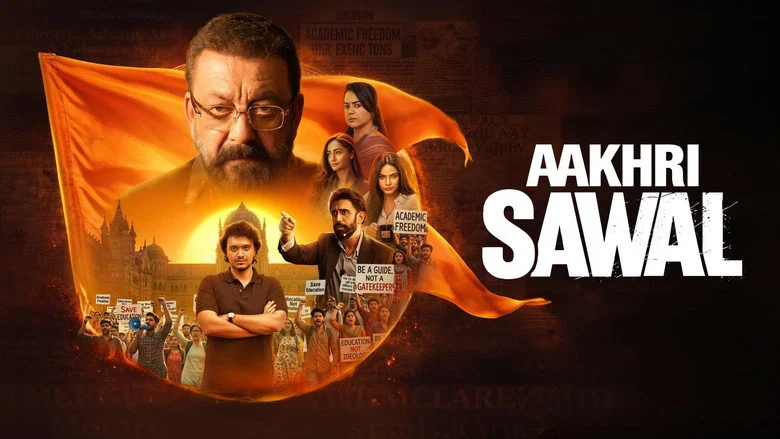
Aakhri Sawal (2026): Sanjay Dutt s lifts key stretches, not the full runtime


There is a moment early in Aakhri Sawal when Vicky, a volatile scholar, stands across from his mentor Professor Gopal Nadkarni and turns a thesis rejection into a public accusation of institutional bias. The air in the room is thick with betrayal, but the film is already signaling its true interest: not the wound between two academics, but the feeding frenzy that awaits them beyond the university gates.
This is a political drama that believes its subject matter is enough, mistaking volume for insight at nearly every turn. For fans of Sanjay Dutt’s particular brand of gravitas, there is a film worth sitting through. For anyone hoping for a sharp examination of ideology, media, and mentorship, this 1 hour 57 minute affair will feel like a lecture delivered through a megaphone.
Sanjay Dutt’s Confrontation Sequences Are The Only Reason To Stay Seated
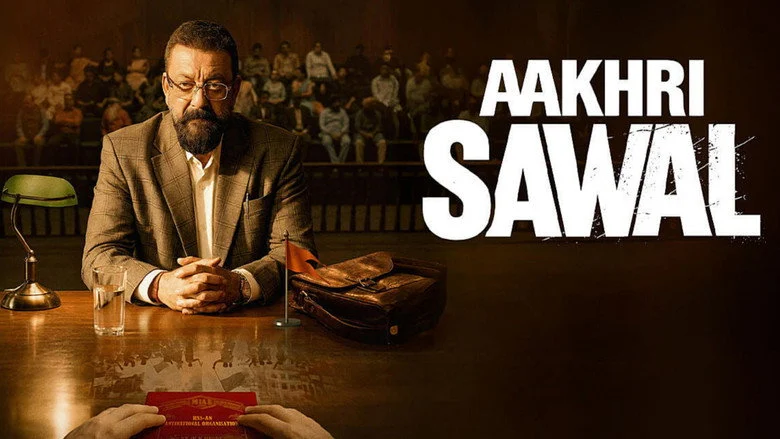
Dutt anchors the film as Professor Gopal Nadkarni, and his confrontation-heavy sequences are the most discussed in the film for good reason. He brings a weary authority to the mentor role, a man whose institutional faith is being dismantled in real time by a student he once nurtured.
His presence gives the central tension a physical weight that the screenplay cannot match on its own. When he squares off against the accusations, you feel the gravity of a career built on reputation now collapsing under public scrutiny.
Abhijeet Mohan Warang’s Direction Understands Conflict But Not Consequence
Director Abhijeet Mohan Warang handles the high-conflict premise with clarity, maintaining focus on the institutional and media confrontation without losing the thread. The setup, centered on the thesis rejection and university politics, is the film’s most controlled stretch of storytelling.
But the dramatic approach is overly forceful, frequently judged as lacking nuance. Warang and writer Utkarsh Naithani seem terrified that the audience might miss the point, so they underline every ideological beat until the film becomes more didactic than layered.
The Genre Core: A Political Drama That Escalates But Never Excavates
The film uses institutional conflict as its entry point into a broader political debate, escalating a private academic dispute into a national spectacle with unsettling speed. The thesis rejection scene that triggers everything is staged with enough tension to suggest a sharper, more intimate film hiding inside this louder one.
As the media and political machinery take over, the storytelling shifts from character-driven drama to televised theater. The extended debate sections, which critics have called emotionally and ideologically overloaded, become the film’s weakest muscle, repetitive, shouty, and ultimately exhausting rather than illuminating.
Where a thriller might have tightened the screws with procedural detail, Aakhri Sawal relies purely on confrontation staging and media intervention to sustain momentum. The narrative voice gets too loud, preferring declaration over analysis, and the film’s central question, what happens when a private disagreement becomes a public trial, is answered only with more noise.
For more political dramas that balance ideology with craft, browse these Hindi Thriller reviews.
Amit Sadh And Sameera Reddy Represent The Forces That Hijack The Narrative
Amit Sadh plays the political activist who serves as a pressure point in the public escalation, adding intensity to the middle portion of the film. His character represents the opportunistic appropriation of genuine grievance, and Sadh plays that calculation with a slick, unsettling charm.
Sameera Reddy, as the sensationalist news anchor, embodies the media apparatus that amplifies the conflict beyond recognition. She shifts the story from academic disagreement to televised confrontation, and her scenes carry a cynical energy that the film seems unsure whether to condemn or celebrate.
Both actors do what the script asks, but the script asks them to be symbols rather than people. Their casting signals the film’s intent to critique media and political opportunism, yet neither character is given enough interiority to make that critique sting.
The Box Office Verdict And The Audience It Failed To Reach
The film opened to a modest ₹0.40 crore to ₹0.48 crore in India, with a worldwide gross of ₹0.63 crore reported by Republic World and Koimoi. The first week total climbed to ₹2.78 crore net domestically and ₹3.54 crore gross worldwide, per Tenvow and Sacnilk, but the final verdict remains a clear flop.
The audience profile was always narrow, class and Sanjay Dutt fans only, and the film never escaped that box. The politically charged subject matter drew initial attention, but heavy-handed treatment of ideology and perceived melodramatic execution kept family and mass audiences away.
The film’s focus on RSS and ideological debate generated curiosity, but no real controversy or censorship battles emerged to fuel ticket sales. In the end, it was a film that shouted about important things without saying anything particularly new about them.
Sanjay Dutt’s dominant performance style is worth witnessing, and the debate-driven premise has its moments. But the extended ideological showdowns feel less like drama and more like a heated argument you cannot politely excuse yourself from. Watch it for Dutt’s presence, perhaps on a regular screen with low expectations, and you will find a serviceable evening, nothing more.
Critics have noted the film’s timeliness, but timeliness without nuance is just noise. I found myself wishing the film trusted its actors and its audience enough to let the argument breathe instead of shouting it into submission.
Aakhri Sawal is a film that mistakes intensity for insight, and its 2 out of 5 rating reflects a premise that deserved sharper handling. For a mentor-student dynamic with more restraint, see how Pati Patni review handles familiar tension.
If you want a political drama that trusts its audience to think, Rock verdict takes the conceptual gamble this one avoids.
Ankit Jaiswal is the Chief Author, covering Indian cinema and OTT releases with honest, no-filler criticism. An SEO strategist by background, he brings a research-driven approach to film writing, cutting through hype to tell you exactly what's worth your time.