Drishyam 3 (2026): Pathak’s Trilogy Closer Rests on Devgn’s Concealment Craft


Vijay Salgaonkar’s carefully constructed world fractures when an old police investigation resurfaces, threatening to dismantle the carefully layered deceptions that have kept his family safe. The third chapter of Abhishek Pathak’s franchise finds its protagonist cornered, no longer the architect of escape routes, but a man defending the walls he has already built.
Ajay Devgn’s Restraint Over Heroic Gesture
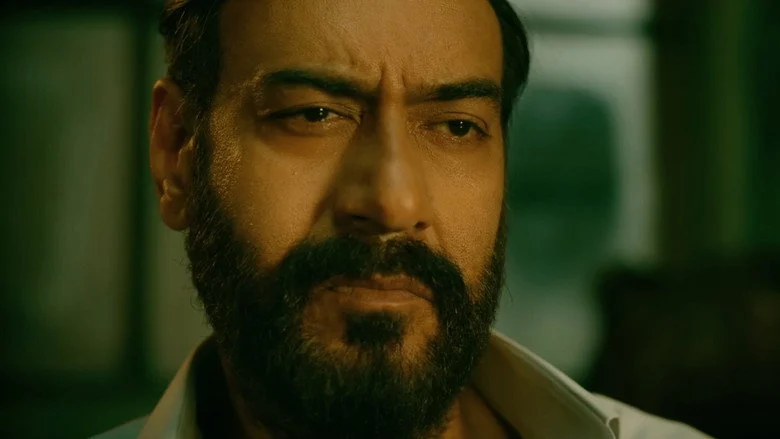
Devgn anchors this finale by refusing to amplify what made Vijay compelling in earlier chapters. The character has aged into a man whose best weapon is stillness, the ability to absorb pressure without cracking, to calculate under duress without visibly sweating. His work here trades explosive reveals for micro-expressions, the kind of disciplined performance that demands a viewer lean in rather than sit back.
Pathak’s Structural Escalation and Screenplay’s Repetition Problem
Pathak frames this as an escalation: a final chapter where prior unresolved conflicts return to haunt his protagonist. The trilogy structure itself signals intent, each film raising stakes, each turning the screw tighter on Salgaonkar’s ability to outmaneuver institutional power. Yet the screenplay, co-written with Parveez Shaikh, risks treading the same deceptive pathways audiences have already walked through two prior installments, suggesting that concealment alone may no longer sustain narrative momentum.
Thriller Mechanics Built on Long-Form Suspense Continuation
The film centers on a police investigation premise that hinges on exposure versus concealment, genre bedrock for thriller construction. Pathak designs the narrative around the return of prior characters, particularly the Deshmukh family conflict, indicating a continuation-driven thriller that accumulates pressure rather than introduces fresh antagonistic terrain.
The trilogy’s escalation logic demands that this finale operate at higher threat density than its predecessors. Devgn’s family, Shriya Saran as Nandini and Ishita Dutta as Anju, return as the emotional collateral against which Vijay’s schemes are measured, anchoring the thriller’s emotional stakes within domestic vulnerability rather than pure crime-puzzle mechanics.
A final-chapter thriller lives or dies on whether it resolves long-form tension or merely extends it. Salgaonkar’s arc depends on whether Pathak grants him tactical victory or moral reckoning, whether the third film rewards his protective cunning or exposes its costs. The surveillance and investigation infrastructure that typically powers crime thrillers becomes secondary to the psychological endurance test: can a man of pure intellect survive when intellect alone cannot guarantee his family’s safety?
Thriller audiences seeking franchise continuity will recognize the DNA here, investigation, misdirection, family under siege. The question becomes whether Pathak trusts the audience’s investment enough to complicate rather than simply repeat the winning formula that carried two successful predecessors into cultural conversation.
For Hindi thriller reviews and deeper analysis of the genre, Hindi Thriller reviews on this platform.
Tabu’s Meera Deshmukh Returns as Institutional Opposition
Tabu anchors the opposing force through her return as Meera Deshmukh, the police-aligned antagonist whose institutional access threatens to unravel Vijay’s carefully concealed history. Her casting signals that this final chapter depends not on a new villain but on the deepening of prior enmity, the notion that obsessive antagonism, when left unresolved across two films, becomes its own momentum toward reckoning.
Franchise Legacy and Audience Expectation Management
The Drishyam films have cultivated a specific audience: thriller devotees interested in crime puzzles, family-drama viewers seeking suspense narratives, and franchise loyalists invested in Salgaonkar’s long-form arc. This finale either delivers meaningful closure or extends uncertainty, a risk calculation Pathak must have weighed carefully when committing to a trilogy conclusion rather than indefinite extension.
Those seeking light entertainment should look elsewhere; this is a franchise built on deception’s weight, not its charm. The film’s terrain belongs entirely to audiences willing to sit with sustained tension and the moral ambiguity of a protagonist whose greatest gift, the ability to deceive, cannot shield him from all consequences.
Devgn and Pathak have constructed something deliberately constrained: a thriller finale that trusts its audience’s memory of two prior films and builds nothing but escalation atop that foundation. Whether that focused ambition becomes the film’s strength or its ceiling depends entirely on execution, on whether the third act delivers earned catharsis or merely professional competence.
The film operates squarely within a proven thriller register, prioritizing the architecture of suspense over the spectacle of resolution. For viewers who have followed Salgaonkar’s journey across two chapters, this is essential viewing; for those seeking franchise entry, the preceding films are non-negotiable preparation. I find myself cautious about whether a trilogy conclusion can meaningfully resolve what two films have deliberately left open, though Devgn’s commitment to interiority may yet prove sufficient to justify the extended investigation.
Drishyam 3 is a competent thriller finale that banks on franchise investment and lead-actor discipline rather than fresh narrative terrain, a 3/5 film for loyalists, a skip for those arriving uninitiated.
Chand Mera Dil similarly explores Chand Mera review.
Michael also prioritizes Michael verdict.
Ankit Jaiswal is the Chief Author, covering Indian cinema and OTT releases with honest, no-filler criticism. An SEO strategist by background, he brings a research-driven approach to film writing, cutting through hype to tell you exactly what's worth your time.