
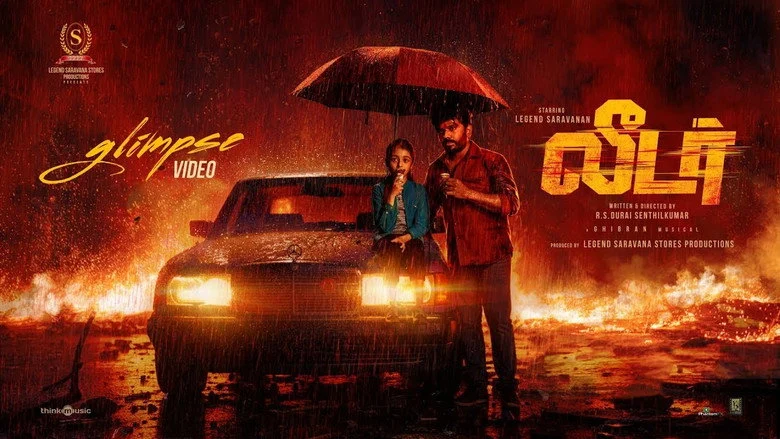
Leader (2026): Legend Saravanan Anchors High-Stakes Crime Thriller With Calculated Risk



An ordinary man with blood on his hands finds himself cornered between smugglers moving ammonium nitrate and law enforcement closing in from all sides. Legend Saravanan’s Sakthivel becomes the fulcrum in a dangerous game where survival means making increasingly violent choices, and the film never lets him, or us, catch breath long enough to question what we’re watching.

R.S. Durai Senthilkumar’s Momentum-First Gambit
Director R.S. Durai Senthilkumar structures this as a relentless series of action and emotional montages, and the approach works because nothing sits still long enough for interrogation. His choice to prioritize kinetic forward motion over psychological depth is both the film’s greatest asset and its central liability. The interval sequence, where Sakthivel hunts down a container truck carrying explosives and detonates it in a display of raw determination, proves Senthilkumar understands how to build momentum through spectacle.
Action Built on Velocity, Not Architecture
The film’s primary strength lies in its refusal to let scenes breathe. Every moment pivots toward the next confrontation, the next escape, the next moral compromise Sakthivel must accept. This relentless pacing creates a propulsive energy that keeps viewers locked into the narrative’s forward momentum.
Where the action framework falters is in geography and spatial clarity. Without detailed breakdowns of setpiece construction or choreography specifics, the film’s combat and chase sequences feel driven more by urgency than by carefully designed sequences where we understand character movement and environmental stakes.
Ghibran’s background score sustains this pulse even when the writing itself goes slack, weaving songs into the narrative fabric rather than interrupting it. The composer’s decision to keep the score moving in tandem with Senthilkumar’s editing philosophy prevents the film from collapsing during its thinner emotional passages.
Tamil action cinema has room for films that prioritize velocity over intricacy. Tamil Thriller reviews consistently show audiences responding to propulsive narratives that trust forward momentum as narrative device.
Andrea Jeremiah and Shaam Anchoring the Law’s Side
Andrea Jeremiah inhabits Inspector Indra as the moral counterweight to Sakthivel’s escalating desperation. Her casting suggests Senthilkumar intended to create a female authority figure who isn’t softened by proximity to the protagonist, a choice that shifts the film’s gender politics toward confrontation rather than romance or sympathy. Shaam’s SP Bakthavachalam operates in similar terrain, a lawman whose methods may blur the same lines Sakthivel crosses.
A Thriller Without Ideological Hesitation
No controversies have emerged around the film’s treatment of explosive devices, criminal networks, or law enforcement brutality. This absence itself signals something: Senthilkumar appears to have threaded a needle where the subject matter remains volatile enough to engage but clean enough to avoid regulatory friction. The film’s willingness to center a man with a lethal past and present it as pragmatism rather than pathology carries risk, and that risk is precisely what makes the premise worth exploring.
For viewers seeking a Tamil action film that refuses to apologize for its protagonist’s moral flexibility, Leader delivers exactly what its title promises: a man who takes control of a catastrophic situation through whatever means necessary. Sakthivel’s defining line, spoken with the casual authority of someone who’s already made his choice, captures the film’s entire philosophy. Watch it for the interval sequence and Ghibran’s work if you prize directional momentum and sonic propulsion; skip it if you require spatial clarity in action or moral complexity beneath the surface.
Leader is an efficiently executed genre exercise that understands its own limitations and converts them into assets, a 2.5-star gamble that plays to its strengths and avoids its weaknesses with disciplined filmmaking.
Senthilkumar’s previous film Biker review similarly wrestles with masculine vulnerability beneath surface action.
Both films share Youth verdict in ways that divide audiences.

Ankit Jaiswal is the Chief Author, covering Indian cinema and OTT releases with honest, no-filler criticism. An SEO strategist by background, he brings a research-driven approach to film writing, cutting through hype to tell you exactly what's worth your time.