
Raja Shivaji (2026): Riteish Deshmukh’s Epic Ambition Anchored in Historical Spectacle



Shivaji’s family bleeds under political oppression before his birth, the film opens not with a hero’s birth but with the conditions that forged him. By the coronation sequence, where he ascends as Chhatrapati, we understand this is a filmmaker intent on earning every frame of his three-hour canvas through historical architecture rather than star vehicle shorthand.
Riteish Deshmukh directs his own historical drama with the patience of someone who respects the weight of his subject. The question is whether that respect translates into cinema that justifies its ambition, or merely performs it.

Riteish Deshmukh as Warrior and Sovereign
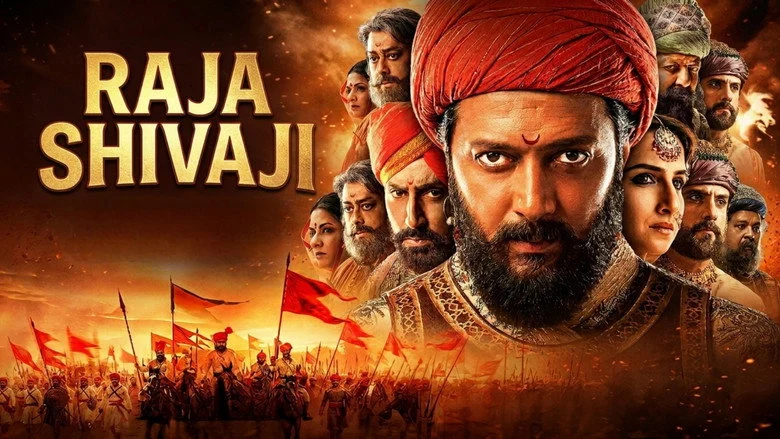
Deshmukh carries the film’s emotional gravity with visible commitment, moving credibly between the young strategist plotting against oppression and the ceremonial authority of his coronation. Early reactions singled out his performance as the film’s anchor, and the range required, from resistance fighter to kingdom-builder, suggests he understood the scale of the role beyond its biographical scaffolding. His command in courtroom and battlefield scenes grounds the historical narrative in human stakes rather than monument worship.
Nine Chapters as Structure, Not Ornament
Deshmukh organizes his narrative through nine chapters, a choice that signals formal ambition but risks becoming scaffolding without momentum. The opening section depicting family oppression and political violence establishes stakes early; the structure suggests an intent to layer complexity rather than rush toward spectacle. Whether this framework sustains across 186 minutes or becomes self-conscious padding remains the film’s central craft gamble.
Battle and Biography in Historical Action
The Afzal Khan confrontation is the film’s emotional crucible, Sanjay Dutt’s antagonist represents not merely a military obstacle but ideological opposition. The staging here determines whether historical action breathes as dramatic conflict or calcifies as choreographed tribute. Early reactions praised Dutt specifically, suggesting the scene carries genuine tension rather than predetermined pageantry.
The coronation sequence operates as the film’s thematic resolution, where individual ambition transforms into sovereign legitimacy. This final authority-establishing moment tests whether the narrative has earned its ceremonial weight through the preceding two hours or merely assembles it at the end. The multilingual spectacle, spanning Hindi, Marathi, and Telugu, mirrors the geographical scope of Shivaji’s ambition, though whether this linguistic reach serves the story or fragments it remains unclear.
Battle sequences anchor the war-film dimensions here. Large-scale staging appears present, but the craft distinction between impressive set design and choreographically coherent action sequences isn’t confirmed in early reactions. The film’s visual ambition is noted as “breathtaking, ” yet specificity about stunt geography or spatial clarity in combat remains absent from available analysis.
Explore more titles in our Marathi Action reviews section for historical epics and period warfare.
Sanjay Dutt and Abhishek Bachchan in Opposition
Dutt’s Afzal Khan registers as a genuine antagonistic force rather than a ceremonial villain, early reactions specified his performance, which suggests textured opposition rather than one-note menace. Abhishek Bachchan, cast as Sambhaji Shahaji Bhonsale, also drew specific praise, though his character’s function within the resistance narrative isn’t detailed. Both actors appear positioned to complicate the biographical framework beyond simple hero-versus-tyrant geometry.
Ajay-Atul’s Score as Thematic Anchor
The music by Ajay-Atul is repeatedly singled out in early audience reactions as a standout element. For a historical epic, the score’s role in emotionally framing political struggle becomes as essential as dialogue. Early praise suggests the music doesn’t merely accompany scenes but shapes their emotional register, a crucial distinction in biographical cinema where the audience arrives with predetermined expectations about historical outcomes.
Raja Shivaji commits itself to a formal approach: nine-chapter structure, multilingual production, 186 minutes of screen time, and a cast assembled specifically for this account of swarajya’s foundation. The result is either a filmmaker trusting his audience to sit with historical complexity, or one mistaking reverence for engagement. I lean toward the former, though the distinction between ambitious patience and indulgent length often hinges on execution across scenes we cannot yet evaluate directly. Times of India reported that early reactions indicated “a strong, impactful reception, ” though published critical scores remain unavailable for assessment.
Watch this if you value historical biographical scope over conventional dramatic momentum, and if three hours devoted to state formation rather than personal triumph aligns with your patience threshold. The coronation alone may justify the runtime; the nine chapters preceding it will test whether ceremonial framing substitutes for dramatic propulsion.
For similar studies in historical resistance, Drishyam 3 review examines authority differently.
Both films construct authority through layered narrative structure, though one builds kingdoms while the other conceals truth.

Ankit Jaiswal is the Chief Author, covering Indian cinema and OTT releases with honest, no-filler criticism. An SEO strategist by background, he brings a research-driven approach to film writing, cutting through hype to tell you exactly what's worth your time.