

Songs of the Djinns (2026): A Fragmented River Dream for the Patient Few



On New Year’s Eve, two actresses drift through the labyrinthine ghats of Varanasi, their aimless wander a prelude to a story that refuses to sit still. Roman Mikhailov’s latest India-set experiment then cuts to Goa, where pop stars and crowds gather for a festival, before settling on a riverboat where strangers trade tales like currency. This is not a film that meets you halfway; it expects you to board its vessel and surrender to the current.

Vyom Yadav and Manasvi Mamgai Anchor a Deliberately Loose Ensemble
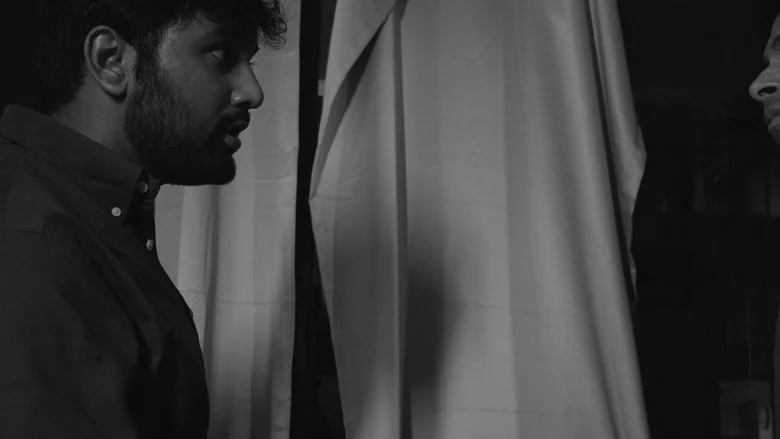
Vyom Yadav and Manasvi Mamgai carry principal roles, though Mikhailov’s design doesn’t offer them conventional hero arcs. They exist as presences within a wider human canvas, their performances more about inhabiting a mood than driving a plot.
Yadav’s stillness suggests a performer comfortable with ambiguity, while Mamgai brings a grounded quality to the film’s more ethereal stretches. Their work signals a trust in atmosphere over exposition, which suits the film’s fable-like ambitions even when it tests patience.

Mikhailov’s Direction Favors Texture Over Narrative Momentum
Mikhailov’s strength lies in braiding Varanasi’s sacred chaos with Goa’s manufactured celebration, creating a visual dialogue between spiritual and synthetic spaces. The river journey that anchors the second half gives the film a unifying, liminal gravity.
Yet the screenplay’s non-linear, vignette-driven structure never fully resolves its threads, and the 93-minute runtime feels both too brief for its ideas and too long for its momentum. A conventional plot is not the goal here, but clarity occasionally suffers for it.

The Genre-Core Execution: Drama as a Shared Listening Act
The film’s drama is built not on conflict but on the search for connection, the recurring plea to “hear the singing of the genies” becomes a metaphor for understanding what hides beneath visible reality. Music functions as narrative structure rather than spectacle, with performance woven into the characters’ search for meaning.
The ship sequence, where storytellers alternate as the vessel drifts past ruined palaces, is the film’s most potent image, a floating stage where speech and song become the only navigation tools. It is here that Mikhailov’s vision of drama as a collective act of listening fully crystallizes.
However, this abstract, fragmented approach will frustrate anyone expecting conventional dramatic stakes. The absence of a clear antagonist or action arc means the tension must come from atmosphere alone, which is a demanding ask for a mainstream audience.
For those drawn to this kind of lyrical, unconventional storytelling, Hindi Drama reviews offer more explorations of similarly patient cinema.
An Ensemble That Serves the Whole, Not the Individual
Anastasia Neginskaya, Vladimir Trushnikov, and Artem Kisakov populate the margins, each contributing to the film’s polyphonic texture. Disha Thakur and Rajat Sukhija’s inclusion signals a genuine cross-cultural collaboration, even if their specific moments remain underdeveloped in the available material.
Svetlana Bondarchuk and Julia Volkova add weight to the cast list, their presence suggesting a production that values cultural exchange as much as narrative payoff. This is an ensemble built for texture, not for spotlight-stealing turns.
A Film for the Festival Circuit, Not the Multiplex
This is a work that will likely find its audience among Mikhailov’s followers and admirers of India-themed experimental cinema, not among those seeking a conventional dramatic payoff. The film’s fragmented structure and abstract themes are its signature, but they are also its barrier to entry.
Comparisons to Mikhailov’s own “We Should Make Movies About Love” and his broader India cycle are inevitable; this feels like an extension of that vision, pushing further into musical allegory. Whether it succeeds where others have stumbled depends entirely on your tolerance for cinema that prioritizes mood over meaning.
If you are willing to surrender to its river-like drift and accept that some threads will remain loose, there is a hypnotic quality to this journey. Watch it on a large screen where the Varanasi imagery and the misty river can envelop you, but know that this is a niche experience, a class-film for fans only. I found myself admiring its ambition more than enjoying its execution, a common fate for films this committed to their own internal logic.
Songs of the Djinns is a demanding, occasionally mesmerizing oddity that earns a reserved 2.5 out of 5 for its singular vision, even as it tests the patience of all but the most devoted cinephiles.
For a more grounded character study, TAXILA review offer a different kind of dramatic satisfaction.
Those seeking a tighter ensemble drama might find Kalyanamaram verdict more rewarding.

Ankit Jaiswal is the Chief Author, covering Indian cinema and OTT releases with honest, no-filler criticism. An SEO strategist by background, he brings a research-driven approach to film writing, cutting through hype to tell you exactly what's worth your time.