
Thimmarajupalli TV (2026): A Small Screen Mystery That Loses Its Signal



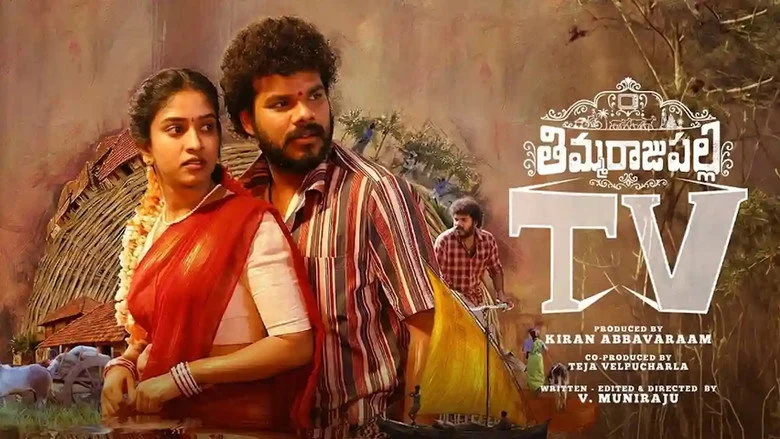
In 1996 rural Andhra, a single television set commands the village’s evening hours like a minor deity. When it vanishes, Sai Tej’s character shifts from peripheral observer to reluctant investigator, and his progression carries the film’s emotional weight.
His performance stays deliberately low-key, reactions measured, silences weighted. There is no explosive confrontation, no manufactured anger. Instead, Tej lets the mystery seep into him gradually, and that quiet approach suits the film’s modest ambitions.
The role demands patience rather than fireworks, and Tej delivers exactly that. He makes the outsider-to-involved-man arc feel believable, even when the script around him wobbles.

V. Muniraju’s Direction Finds Texture in Period Detail, But Loses Grip on Pacing
Muniraju clearly understands the power of a shared object in a closed community. The television becomes a social anchor, families gather, hierarchies form, and the evening schedule dictates collective behavior. That setup is the film’s strongest hand.
Yet the screenplay’s linear structure struggles to sustain complexity beyond the first hour. The mystery framework stays modest, and the later stretches feel stretched thin, with emotional beats landing unevenly against the suspense threads.
The 1996 period design, however, is never merely decorative. It shapes how the village talks, behaves, and reacts, giving the drama a lived-in authenticity that compensates for narrative thinness.
The Community Itself Is the Antagonist, and That’s Both the Film’s Boldest Choice and Its Weakest Link
There is no named villain in Thimmarajupalli TV, and that absence is deliberate. Suspicion spreads like a slow fever across the village, turning neighbors into accusers and friendships into fragile alliances. The search sequence, where the entire community mobilizes, becomes a web of mutual distrust, every glance carries a question.
This communal framing gives the drama a social dimension that typical Telugu thrillers avoid. The missing TV is less a mystery object than a mirror held up to the village’s own anxieties, fears, and buried resentments. The question “who took it” quickly becomes “what do we really know about each other.”
But the payoff doesn’t match the setup. The reveal, when it comes, feels underwhelming, the emotional consequences are acknowledged rather than deeply explored, and the suspense deflates rather than detonates. The premise promises more than the execution delivers.
For a film that builds its entire world around a single object, the resolution needed sharper teeth. Instead, we get a gentle landing that respects the community but shortchanges the mystery.
If you’re drawn to rural dramas where the setting breathes, there’s plenty more worth exploring in our Telugu Drama reviews.
Supporting Cast Builds the Village’s Social Fabric, One Face at a Time
Veda Jalandhar appears as part of the central relationship dynamic, grounding the emotional stakes in something personal. His presence gives Sai Tej’s journey a human counterweight, even if the script doesn’t fully develop their connection.
Pradeep Kotte features prominently in the ensemble-driven conflict, contributing to the suspicion-laden atmosphere that defines the middle portions. His casting signals the film’s commitment to character actors over star power, a choice that keeps the village setting grounded and believable.
Swathi Kalimireddy rounds out the supporting texture, her role reinforcing the interpersonal tensions that simmer beneath the village’s cooperative surface. Together, these performers create a believable ecosystem, even when the writing doesn’t give them enough to chew on.
A Flop Verdict That Reflects Both Box Office Reality and Narrative Limits
TollyBO reports the film’s first-week India net collection at ₹1.55 Cr against a worldwide gross of ₹1.75 Cr, officially declaring it a Flop. Those numbers tell a story of limited theatrical traction, but they also mirror the film’s own constraints, a simple premise that couldn’t sustain wide commercial appeal.
Audience response echoes the critics’ mixed reception. Viewers praise the 1996 period design and the originality of centering a TV set as the story’s fulcrum, but complaints about thin plotting and sluggish middle sections recur frequently. The family-and-community focus is appreciated, yet the suspense payoff leaves many wanting more.
CineJosh’s average critic rating of 2.75 out of 5 captures the film’s fundamental tension: admirable intentions, modest execution. The first half’s strong setup gives way to a second half that depends too heavily on payoff it can’t quite deliver.
What ultimately lingers is the film’s conviction that a shared object can define a community’s identity. That idea, more than the mystery itself, is worth the watch, if you have patience for the slow burn.
Sai Tej’s restrained performance and Muniraju’s period sensitivity make Thimmarajupalli TV a curious experiment rather than a complete success. For those who appreciate rural texture and community-driven drama, it offers genuine rewards, but the uneven pacing and underdeveloped suspense will test less forgiving viewers. Watch it for the setting, the performances, and the bold premise, just don’t expect the mystery to keep you on the edge of your seat. A modest 2.5 out of 5, best enjoyed on a streaming platform where you can pause and breathe.
For a sharper take on community-driven storytelling, check out Itllu Arjuna review.
If restraint in performance is what you seek, Aadharam verdict offers a more disciplined execution of similar instincts.

Ankit Jaiswal is the Chief Author, covering Indian cinema and OTT releases with honest, no-filler criticism. An SEO strategist by background, he brings a research-driven approach to film writing, cutting through hype to tell you exactly what's worth your time.