
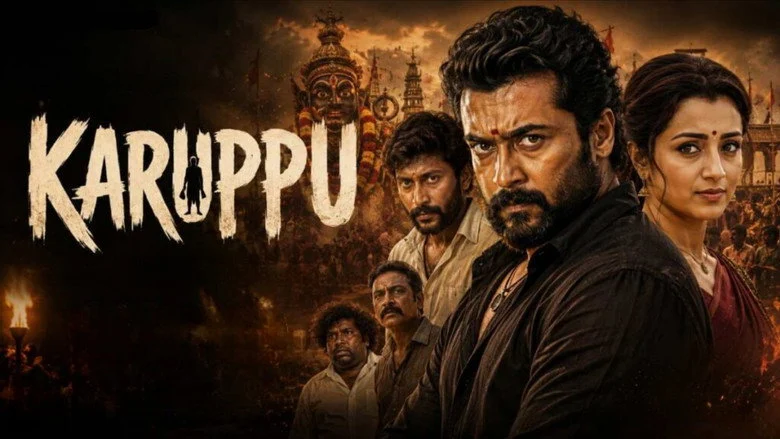
Karuppu (2026): Suriya’s Courtroom Mode Wins, Divine Logic Falters



A divine guardian materializes as a lawyer inside a corrupt courtroom, ready to restore justice for a wronged father and daughter. The moment he opens his case file, Karuppu commits itself to a structure that works, until it forgets to keep faith with the law.
RJ Balaji’s premise arrives fully formed: what happens when a supernatural force operates under human rules? The film understands this tension best in its courtroom sections, where the fantasy scaffolding recedes and the legal machinery takes centre stage. But the screenplay cannot sustain this discipline across all 150 minutes, and the result is an uneven drama that peaks in the witness box and deflates the moment divinity reasserts itself.

Suriya Anchors the Courtroom, Drifts in the Divine
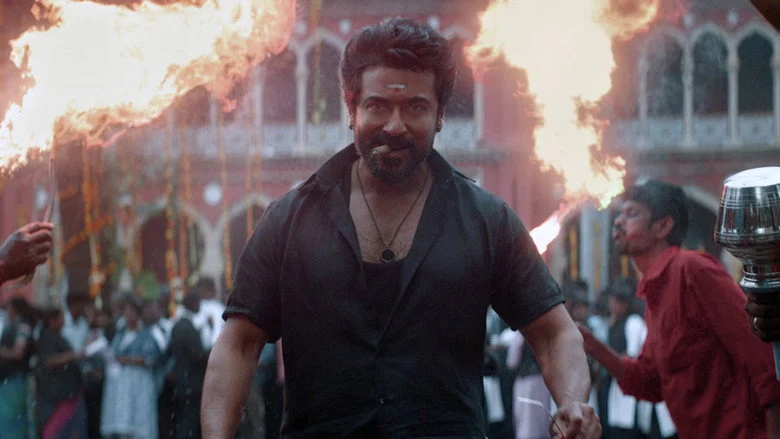
Suriya carries the film through its legal proceedings as Saravanan, the lawyer-figure incarnation of Karuppuswamy. In the courtroom sections, his anchor holds, he reads testimony, cross-examines with purpose, and shoulders the moral weight of the case without relying on supernatural sleight of hand. When the film stays grounded in human conflict, he elevates it.
The problem surfaces the moment the screenplay demands he toggle between lawyer and guardian. His performance doesn’t fracture, but the material does, and no actor can fix that imbalance. The role itself reveals the film’s central miscalculation: it wanted to marry two genres, but neither one got enough oxygen.
RJ Balaji’s Script Knows Its Courtroom Strength, Forgets It
The director-writer constructs a high-concept framework, divine intervention bound by legal rules, that should generate sustained tension. The courtroom portions deliver this. The moment an antagonist demands that Karuppu win without using divine powers, the film enters its most controlled and credible phase.
What weakens the film is its drift into the familiar divine-intervention template the moment the courtroom closes. The screenplay leans too heavily on the fantasy framing when it should be leaning the opposite way. The best version of this film stays seated in the judge’s chambers.
The Fantasy Framing Never Settles Its Own Rules
Action drama built around a legal conflict should generate stakes through courtroom procedure and emotional vulnerability, not through the threat of supernatural intervention. Karuppu understands this when it focuses on the father-daughter case and the corruption that surrounds it. The emotional setup carries weight because it is grounded in systems we recognize.
The problem emerges when the fantasy logic takes over. The film cannot decide whether divine power dilutes tension or sustains it. The sequences where Karuppu operates as a pure guardian feel less controlled than those where he operates as an advocate within rules. This inconsistency is not a flaw in craft, it’s a conceptual failure. The screenplay chose two masters and couldn’t serve both.
The central confrontation, where the antagonist forces a rule-bound contest, is where the film finds its footing. This is the film’s most praised section, and for good reason. It strips away the supernatural scaffolding and leaves only the human contest: can justice prevail within a corrupt system without outside intervention? That is a sharper, more honest question than the one the film spends most of its time asking.
Those interested in courtroom drama with thematic complexity should explore Tamil Action reviews for similar narrative experiments.
Trisha and RJ Balaji Navigate Supporting Terrain
Trisha Krishnan appears as Preethi, situated within the core emotional narrative tied to the father-daughter conflict. Her character functions as part of the story’s moral centre, though the research confirms no scene-specific moment where her performance distinctly separates itself from the ensemble.
RJ Balaji, playing Baby Kannan (BK), occupies an operational role that suggests story-supporting functionality. Neither supporting turn receives the dramatic architecture to break through, which itself signals how the film distributes its attention unevenly across courtroom versus fantasy sequences.
The Antagonist’s Challenge Reframes the Entire Story
The villain’s structural importance lies in his ability to force a reset: win the case without divine powers. This single demand shifts the film from divine intervention into rule-bound contest, and it is the moment when Karuppu becomes honest about what it actually wants to ask.
An opponent who strips away supernatural advantage is dramatically more interesting than one who simply opposes it. The film knows this. It just doesn’t know how to sustain that insight across all 150 minutes without reverting to the safer fantasy framework.
Karuppu works best when it trusts the legal system as its arena and forgets to rely on the supernatural as its shield. Suriya is more than capable of carrying a grounded courtroom drama, and the central premise has the architecture for one. But the film’s inability to commit fully to either genre, to choose between exploring divine justice or exploring human justice through legal procedure, leaves both halves undernourished. The courtroom sequences hint at a stronger film, one that exists just outside the frame of what was actually made.
Watch this for Suriya in the legal sequences and for the specific challenge to fight corruption within the rules. Skip it if you need thematic consistency or genre discipline. The film is most honest when it stays inside the courtroom and most confused when it steps out.
The screenplay borrows familiar ground from KD Devil review without developing its own voice.
Karuppu is a premise that wins in its best courtroom moments but loses itself in the fantasy spaces between them, a 3 out of 5 film that shows stronger craft than final execution allows.
Both films struggle to balance heightened concepts with grounded emotional stakes, as seen in Krishnavataram Part verdict.

Ankit Jaiswal is the Chief Author, covering Indian cinema and OTT releases with honest, no-filler criticism. An SEO strategist by background, he brings a research-driven approach to film writing, cutting through hype to tell you exactly what's worth your time.